


By Patience Gondo
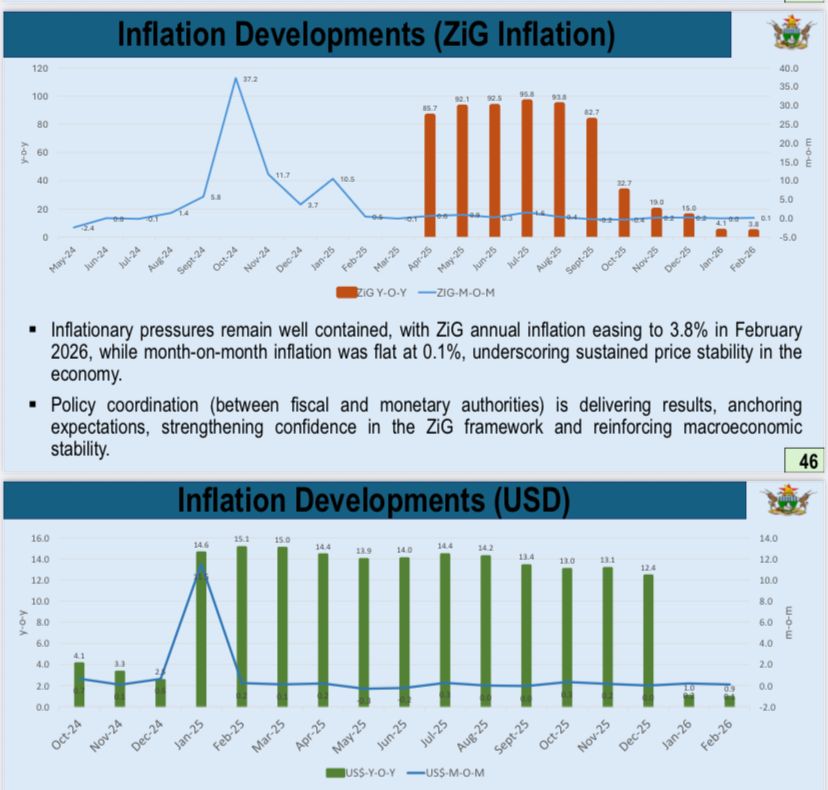
THE government is targeting sustained single-digit inflation after US dollar inflation dropped sharply to 0.9 percent year-on-year in February 2026, signalling easing price pressures across the economy.
Month-on-month US dollar inflation remained low at 0.1 percent, indicating stable prices for goods and services.
Chief Director in the Ministry of Finance, Joseph Mverecha said the decline reflects improved policy coordination and firm control of money supply.
“This shows that inflation is now under control and we are moving towards sustaining single-digit inflation,” he said.
The trend is also reflected in the local currency, with ZiG annual inflation standing at 3.8 percent in February 2026, while month-on-month inflation remained at 0.1 percent.
Low and stable inflation is key to protecting consumers from rising prices and creating a predictable environment for businesses and investment.
Mverecha said government, under Finance Minister Mthuli Ncube, is committed to maintaining inflation within single digits through disciplined fiscal and monetary policies, in line with regional economies such as South Africa.
He said while inflation is stabilising, broader economic transformation will take time.
“No country under the sun has eliminated poverty within five years,” he said, citing China and Vietnam as examples of economies that achieved long-term growth through sustained reforms.
“We might stay in the course for the next 10 years to achieve meaningful transformation,” he said.
Mvechere also said strong diaspora remittance inflows are also supporting economic stability, rising from about US$922 million in 2019 to around US$2.8 billion in 2025, with projections pointing to further growth to US$3 billion in 2026.
“The increased foreign currency inflows are helping to stabilise the exchange rate and reinforce low inflation.” He said.
Zimbabwe’s economy is projected to grow by around 5 percent in 2026, supported by improved price stability and strengthening economic fundamentals.