


By Rex Mphisa
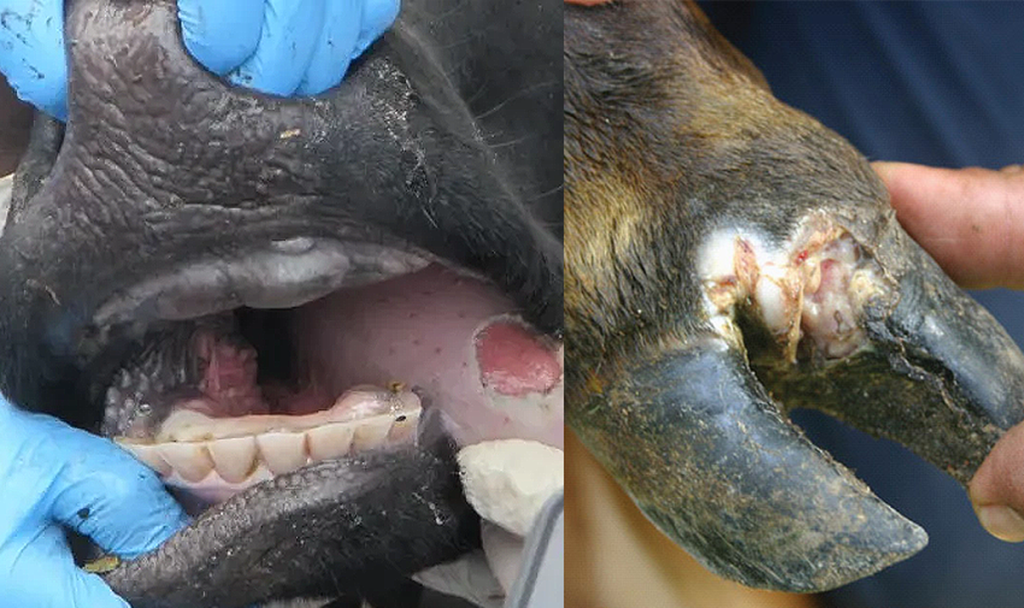
THE South African government has pointed a finger at Zimbabwe blaming its northern neighbour for the foot and Mouth Disease (FMD) rocking the country.
While naming Zimbabwe as its major challenge, SA however pours cold water on buffalo escaping from its patks as the main source of the disease affecting its beef industry.
SA said this week the lack of a border fence between the two countries and broken redline fences are compounding the spread FMD in Limpopo province bordering Zimbabwe.
The claim was made by SA Agriculture Minister John Steenhuisen has said.
He was leading his country’s fourth nationwide mass vaccination roll-out campaign against the foot and mouth disease, at Polokwane, 200 kilometres south of Beitbridge.
The campaign has been rolled out in Gauteng, Free State and KwaZulu-Natal.
Steenhuisen says stray buffaloes from Zimbabwe and the Kruger National Park are some of the major sources of the foot and mouth disease in Limpopo.
African buffaloes are natural hosts and carriers of the foot and mouth disease virus.
He said the porous borders between South Africa and Zimbabwe allows free movement of animals between the two countries.
Instead of looking at the traditional elephants movements, Steenhuisen says jumbos “migrating from Zimbabwe in search of grazing and suitable habitant” also break down the veterinary cordon fence, commonly known as the redline fence.
Elephants exhibit complex, large-scale movement patterns driven by seasonal resource availability, water dependency, and social structure, often covering daily.
They use fast, straight-line movements to reach water or mates, but slow down with higher sinuosity (turning) to forage in favorable habitats.
This means they ae naturally driven.
Steenhuisen said Limpopo is one of those provinces that will always require some form of prophylactic vaccination at its interface because it has two major challenges.
“The first is Zimbabwe, as many of the infections we encounter come from across the border. The second is the border area at Kruger National Park, where the buffalo are carriers of FMD. When fences are broken by elephants or other animals, the buffalo escape, leading to cross-contamination with cattle. This obviously creates a unique problem in Limpopo, Mpumalanga, and KwaZulu-Natal,” said Steenhuisen.
Steenhuisen says they are planning on vaccinating over 80% of cattle countrywide by the end of 2026, with the new doses set to arrive soon.
South Africa has a cattle population of approximately 12 to 13.8 million head.
“We are now waiting for the big shipment of vaccines to arrive in South Africa from Biogenesis and from Dolve five million and six million and therefore then really gives us a scale and reach that we need to hit our target of vaccinating 80% of the national herd by December this year. What that will do is reduce the incidents of FMD by around 70%,” he adds.
Steenhuisen is quoted on SA national broadcaster SABC saying the mass vaccination drive is expected to be rolled out across the Limpopo province with immediate effect.