


By Rex Mphisa
ZIMBORDERS’ and Beitbridge’s $300 million upgraded border post went on world show this week and may have secured the Zimbabwean company contracts across Africa.
Its model and modules will be replicated across the continent.
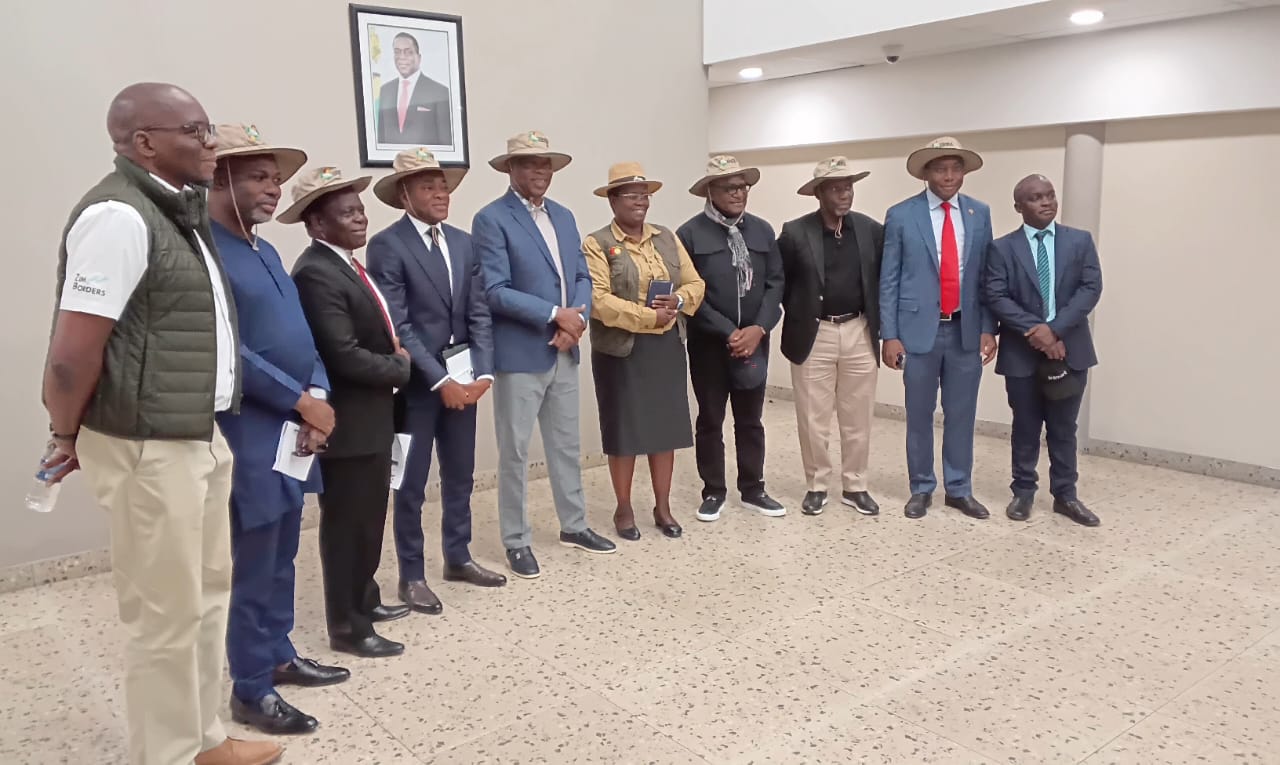
That the infrastructure is world class, brilliant and will be copied across the continent is a joint undertaking by a delegation of officials from Benin, Nigeria and Cameroon who spent a week at Beitbridge on an Africa Import and Export Bank (Afrexim) sponsored Benchmarking Mission.
Collectively these delegates led by Comptroller-General of the Nigeria Customs Service Bashir Adewale Adenyi, the Director-General of the Cameroon Customs Administration Fongod Edwin Nuvaga and the Director-General of the Benin Customs Colonel Raquf said if placed anywhere in the world, the Beitbridge Border Post Infrastructure will match.
They, at the end of the mission signed a tripartal communique to have the Beitbridge model of border posts under the African Continental Free Trade Area (AfCFTA), and specifically within the coordinated effort, pursued with the support of Afreximbank, to facilitate trade within the West African region and between West and Central Africa.
The communique was signed in the presence of the African Export-Import Bank (Afreximbank), which was part of the financers of the ipgrading of the Beitbridge Border Post.
The communique said the Benchmarking Mission “was conceived within the continental framework for deepening intra-African” and two principal trade corridors at Sèmè-Kraké axis linking Nigeria and Benin and the Mfum-Ekok axis linking Nigeria and Cameroon are likely to have the Beitbridge infrastructure duplicated.
“Beitbridge was selected because it demonstrates, in sustained operation and at continentalscale, that a border can facilitate legitimate commerce, protect society and assure revenue concurrently as an authoritative reference for the modernisation of the corridors entrusted to us,” reads part of the communique.
It also said the purpose of the mission was to extract the principles that account for Beitbridge’s performance and their examination against the legal, institutional and operational circumstances of our respective countries.
“Infrastructure was the most visible lesson of Beitbridge; it was not the most consequential. What proved decisive was the operating model: unified accountability for the border as a whole; agencies acting under one coordinated process; technology deployed to simplify procedures rather than to automate their fragmentation; and performance governed by measurable service standards for which named institutions are answerable.
“Border modernisation is, in essence, a programme of institutional reform, resting on decisive leadership, fit-for-purpose legislation, coordinated border management, digital interoperability and professional human capital. Facilities give such reform tangible expression; they are not a substitute for it,” said the communique.
The vising delegates also observed that no border modernises in isolation and a modern post delivers its full value only where procedures, operating hours, data requirements and legal instruments are aligned across the boundary and along the corridor beyond it.
Guided by their several conclusions the three organisations said they would collectively and individually, undertake to champion the development and effective operation of coordinated and One-Stop Border Post arrangements at African strategic frontiers, commencing with the corridors that carry the greatest weight of trade within West Africa and between West and Central Africa.
“We commit to trilateral cooperation as the principal vehicle for this undertaking, and shall establish a Trilateral Strategic Steering Committee, supported by national focal points, to sustain momentum, align priorities and hold our administrations accountable for the outcomes of this mission,” said their joint document.
They also committed to the pursuit of the requisite legal instruments and harmonised procedures; to the advancement of digital interoperability anchored upon pre-arrival processing and coordinated risk management, so that information precedes cargo and controls concentrate where risk genuinely resides; and to sustained investment in the leadership, technical proficiency and integrity of our personnel, upon which the enduring operation of a modern border depends.
Collectively the three expressed profound appreciation to Afreximbank for conceiving and convening this mission and for its continuing role in enabling trade infrastructure across the continent, and invited the Bank to remain a strategic partner as we translate these conclusions into corridor-level action.
“We equally convey our gratitude to the Zimbabwe Revenue Authority and the management and technical teams of the Beitbridge Border Post for their hospitality, candour and generosity,” they said as regards permission of the benchmarking mission.
“We resolve to proceed from benchmarking to implementation, and from isolated projects to an integrated regional border-management architecture and One-Stop Border Post (OSBP) in the service of African economic integration, collective security and common prosperity, and we pledge the sustained leadership attention and institutional discipline that this undertaking demands,” said their document witnessed by Acting Customs and Excise Commissioner Lonto Ndlovu on behalf of Zimbabwe and Gainmore Zanamwe who is the director, Trade Facilitation & Investment Promotion of the Afrexim Bank.
Zimborders general manager Nqobile Ncube said the visit by the West African counties also brought lessons to Zimbabwe which will refine its Beitbridge processes.
“We have also learnt from the delegation in particular an intriguing lesson on a border that handles 1 400 vehicles with just a few border agencies which we should also try,” he said.
Ncube hoped his company would secure contracts to build the border posts across Africa.