


By Chantelle Muzanenhamo
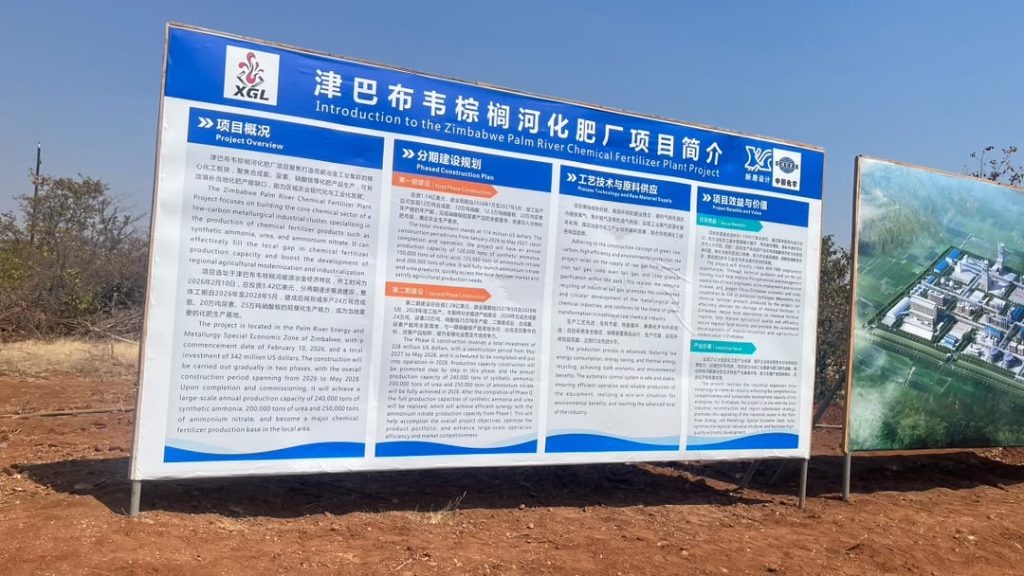
HEAVY industry usually comes with an environmental price tag, but a massive new industrial project rising in Beitbridge is flipping that script turning would-be factory emissions directly into crop nutrients for Zimbabwean farmers.
The US$342 million Chemical Fertilizer Plant Project is part of the Palm River Energy and Metallurgical Industrial Park in Beitbridge, developed by Xintai Resources.
The developers are building a circular manufacturing system that captures raw waste gases from the Ferrochrome Smelting Plant smelting operations and converts them into hundreds of thousands of tons of chemical fertilizer.
According to an official project overview erected at the construction site and seen by Ziyah News Network, the facility is anchored on green, low-carbon engineering.
“Adhering to the construction concept of green, low-carbon, high efficiency, and environmental protection, the project relies on the supply of raw gas from chromium iron tail gas, coke oven tail gas, and coke granule gasification within the park,” the on-site project brief states.
“This realizes the resource recycling of industrial tail gas, promotes the coordinated and circular development of the metallurgical and chemical industries, and conforms to the trend of green transformation in traditional coal chemical industry.”
Closing the Industrial Loop Instead of venting excess gases from ferrochrome smelters and coking plants into the atmosphere, the chemical complex pipes those byproducts straight into its production lines.
Coupled with thermal energy recycling and automated, low-consumption systems, this closed-loop model simultaneously slashes carbon emissions and lowers manufacturing costs.
“The production process is advanced, featuring low energy consumption, energy saving, and thermal energy recycling, achieving both economic and environmental benefits,” the site overview notes.
Once fully operational in May 2028, this recycled-gas system will power an annual output of 240,000 tons of synthetic ammonia, 200,000 tons of urea, and 250,000 tons of ammonium nitrate.
Work officially kicked off on February 10, 2026, with a two-phase rollout designed to bring these eco-friendly fertilizers to the market quickly.
Phase One, backed by US$114 million, is scheduled for completion by May 2027 to deliver 200,000 tons of urea and 125,000 tons of ammonium nitrate annually, before a US$228 million second phase doubles ammonium nitrate capacity by May 2028.
Alongside creating 800 to 1,000 direct jobs and technical training opportunities for locals, the Beitbridge plant sets a new benchmark for sustainable industrialization in Zimbabwe proving that cleaner factories can directly fuel greener, more productive farms.