


By Patience Gondo
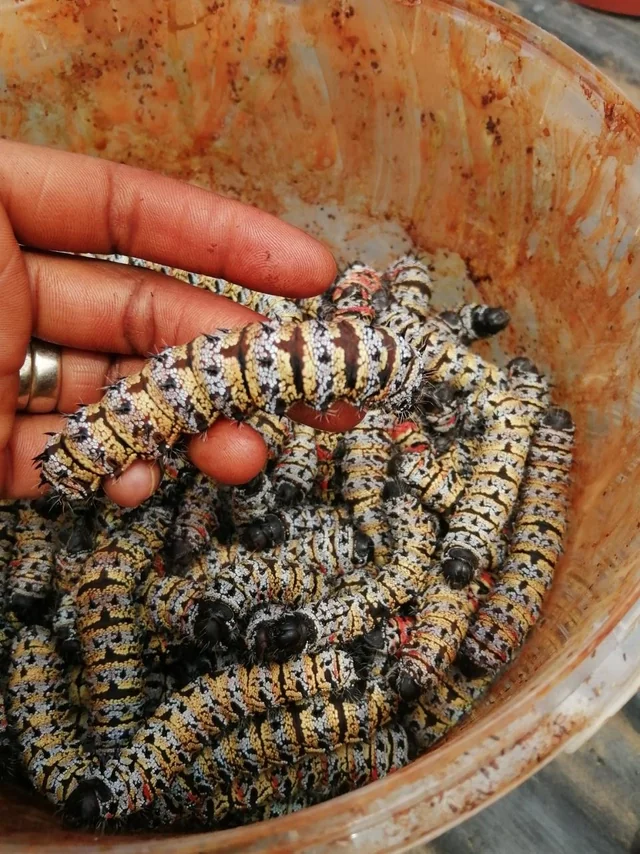
A sharp decline in mopane worms (amacimbi, madora) harvests between 2025 and early 2026 has pushed calls for scientific farming to secure food and income in Matabeleland South.
The proposal emerged during the Matabeleland South Investment Conference in Gwanda on Friday , where tourism and development practitioner Raymond Mauba shared lessons from China, where edible insects are reared in controlled incubation systems to ensure a consistent supply.
Speeking to Ziyah Newsnetwork Mauba said Zimbabwe cannot rely on nature alone. Through scientific incubation and controlled environments, communities can protect this important resource for the future.
He said scientific incubation involves collecting mopane worm eggs or early-stage larvae and raising them in controlled conditions, carefully monitoring temperature, humidity and feeding. Pupa are transferred into boxes and adult moths are released near host trees under netting to lay eggs. Shade cloth and bird deterrents are used to protect the caterpillars during development.
Mauba said semi domesticated methods allow a portion of caterpillars to be released into the wild to maintain natural populations, ensuring that the species continues its life cycle while still supporting community harvests.
“Solar powered drying techniques are also used in China reducing environmental damage and improving product quality,” He said.
Mopane worms (amacimbi) are a vital source of protein and income for people in the Raimbow province
Harvesting has long supported households during droughts and periods of poor crop yields, providing both nutrition and cash.
However, supplies have become increasingly unreliable.
Between 2025 and early 2026, harvests were extremely low in some areas despite good rains and prices surged to over USD 1 per cup in local markets.
Researches cite climate change, El Nino-induced droughts, deforestation, over harvesting and unregulated cross border trade as key factors behind the decline.
Dr Van Asch, a conservation scientist from Stellenbosch University in her research said the unsustainable harvesting may be pushing the species toward local extinction.
“Without immediate attention, these ecosystems and the communities that depend on them risk irreversible change,” she said.
Some local farmers in Zimbabwe are already pioneering sustainable methods.
In Chiredzi, Blessing Mutedzi has been breeding mopane worms since 2015 releasing a portion into the wild to maintain natural populations. His project produces around 20 kilograms of worms per month.
Mauba further said by combining scientific breeding, rotational harvesting, selective collection of mature larvae and policy enforcement will be critical to preserving mopane worms.