


By Ziyah News Netwok
ZIMBABWE is preparing for the first nationwide Rural and Urban Council Competitiveness Index (RUCCI) Survey, with the Zimbabwe National Statistics Agency (ZimStat) and the National Competitiveness Commission (NCC) currently training enumerators ahead of the exercise scheduled for July 3-26.
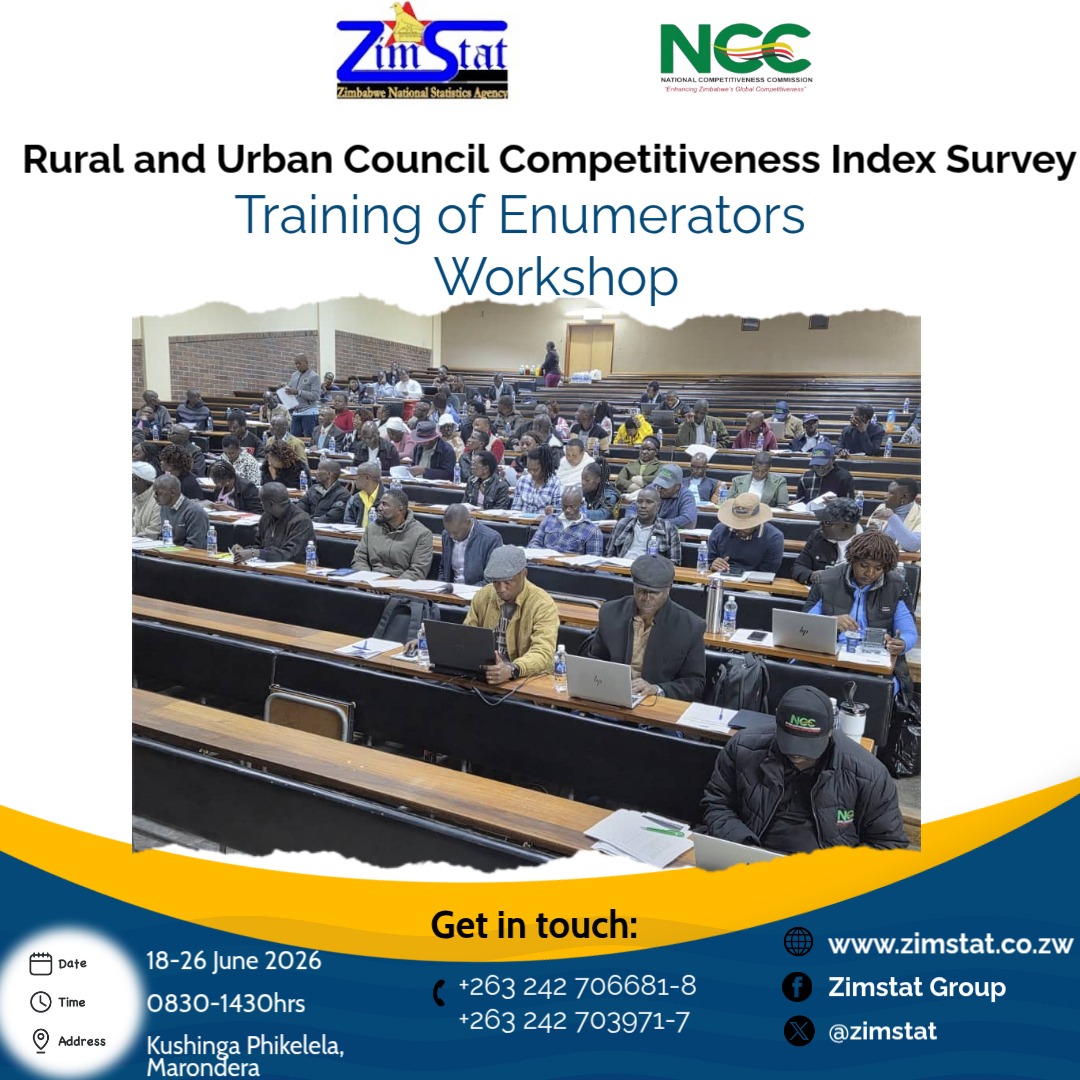
The training workshop, running from June 18 to 26 at Kushinga Phikelela in Marondera, marks the final phase of preparations for what officials describe as a landmark exercise aimed at assessing the competitiveness of local authorities across the country’s 10 provinces.
The survey, a joint initiative involving the NCC, ZimStat, the Ministry of Industry and Commerce and the Ministry of Local Government and Public Works, follows pilot phases and regional rollouts conducted between 2024 and 2025.
According to ZimStat, the data collected will provide critical insights into key drivers of competitiveness, including innovation, inclusiveness, sustainability and resilience.
“The data collected through the survey provides invaluable insights into key determinants of competitiveness, such as innovativeness, inclusiveness, sustainability and resilience. The indicators derived from the survey are used in ascertaining the level of competitiveness by local authorities in Zimbabwe,” ZimStat said.
The survey comes as Zimbabwe embarks on the National Development Strategy 2 (NDS2) (2026-2030), the country’s second five-year blueprint aimed at attaining upper-middle-income status by 2030.
Under NDS2, local authorities are expected to play a central role in driving inclusive growth through improved service delivery, efficient use of devolution funds and the creation of investment-friendly environments.
The RUCCI survey is expected to provide an evidence-based assessment of how councils are performing in these areas, while helping identify gaps that require policy intervention.
In line with NDS2’s emphasis on ease of doing business and structural transformation, the survey will gather feedback from formal and informal enterprises on local authority efficiency, licensing costs and bureaucratic hurdles that affect economic activity.
The exercise is also expected to highlight deficiencies in critical infrastructure and services, including water supply, road networks and waste management systems, which are essential for sustaining productive local economies and industrialisation.
NCC Executive Director Mr David Madzikatire has previously underscored the importance of competitiveness in accelerating economic growth, arguing that strong local institutions are critical in attracting investment and enhancing productivity.
By providing a benchmark for measuring performance, officials believe the survey will help councils align with global best practices and smart-city standards while strengthening accountability and evidence-based policymaking.
With the July rollout set to cover all provinces, the exercise represents the first comprehensive effort to measure and rank the competitiveness of Zimbabwe’s rural and urban councils, providing policymakers with data needed to support devolution, regional development and the broader Vision 2030 agenda.
The Rural and Urban Council Competitiveness Index Survey was conceived by the National Competitiveness Commission and underwent pilot implementation between 2024 and 2025.
The July 2026 exercise marks its first full-scale national rollout and is expected to become an important tool for tracking local authority performance under the National Development Strategy 2.