


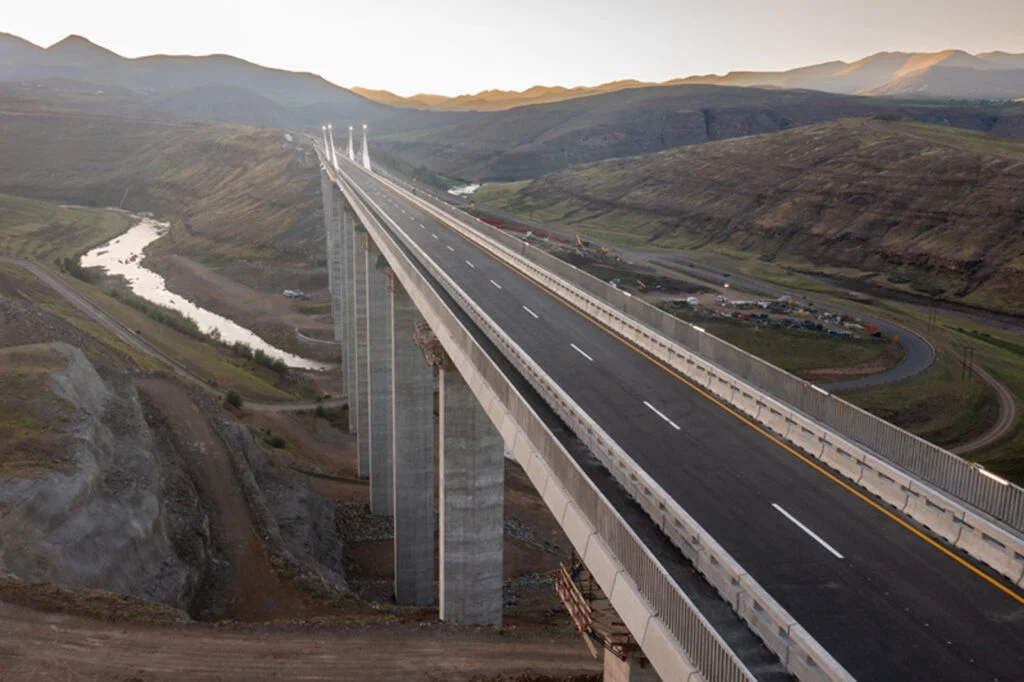
South Africa and Lesotho have opened the Senqu Bridge, reaching an important milestone for Phase II of the Lesotho Highlands Water Project (LHWP).
The new bridge cost roughly R4.2 billion to build and involved construction crews from both countries supporting the LHWP.
The project represents a treaty-based partnership between South Africa and Lesotho that dates back to 24 October 1986, which was established to improve regional integration between South Africa and the small, land-locked, mountainous country.
Additionally, the partnership aims to address water security, energy generation, and socio-economic development for the two countries.
The Senqu Bridge is one of three new elevated roads greenlit by the LHWP, the others being the Khubelu and Mabunyane bridges.
All three bridges were commissioned to ensure continued access across the Polihali Reservoir once water levels rise following the dam’s completion.
The dam is 825 metres in length and 90 metres tall, and the new Senqu Bridge will maintain access to the national road network via the A1, which connects Mokhotlong to Maseru.
Once complete, the dam will increase the local water supply capacity from 780 million cubic metres per annum to 1,270 million cubic metres, improving the region’s water security.
An ambitious project
The Senqu Bridge is the largest of the three elevated routes. It is also the first extradosed bridge in Lesotho, using a cable-stayed and prestressed girder design.
Construction began in 2023 and was completed in February this year; however, the bridge was only opened to traffic a month later.
The bridge deck was constructed in 50-metre sections cast from both ends simultaneously. The structure is supported by 17 piers ranging in height from 15 to 90 metres.
Once the dam is complete, 15 of the 17 will be submerged by the rising water level, reaching a depth of 85 metres at full capacity, according to Engineering News.
An integrated monitoring system will track the structural integrity of the bridge, checking for stress points in the piers, deck, and cables.
Over 10,000 tonnes of steel were used in the construction, and 150,000 cubic metres of rock were excavated for the site.
The South African government noted that the project generated approximately 250,000 person-days of employment for a workforce of 1,200 individuals.
The official opening ceremony was conducted on 22 April 2026 and featured South Africa President Cyril Ramaphosa, the constitutional monarch of Lesotho, King Letsie III, and Prime Minister Samuel Matekane.
“The successful completion of the Senqu Bridge marks the replacement of the existing bridge, which will be submerged once the Polihali Dam is impounded,” wrote the South African presidency.
“In addition, the project will facilitate the transfer of high-quality water to South Africa; generate hydropower for Lesotho; and support the provision of potable water, irrigation, fisheries, and the promotion of tourism.”