


By Patience Gondo at Maphisa
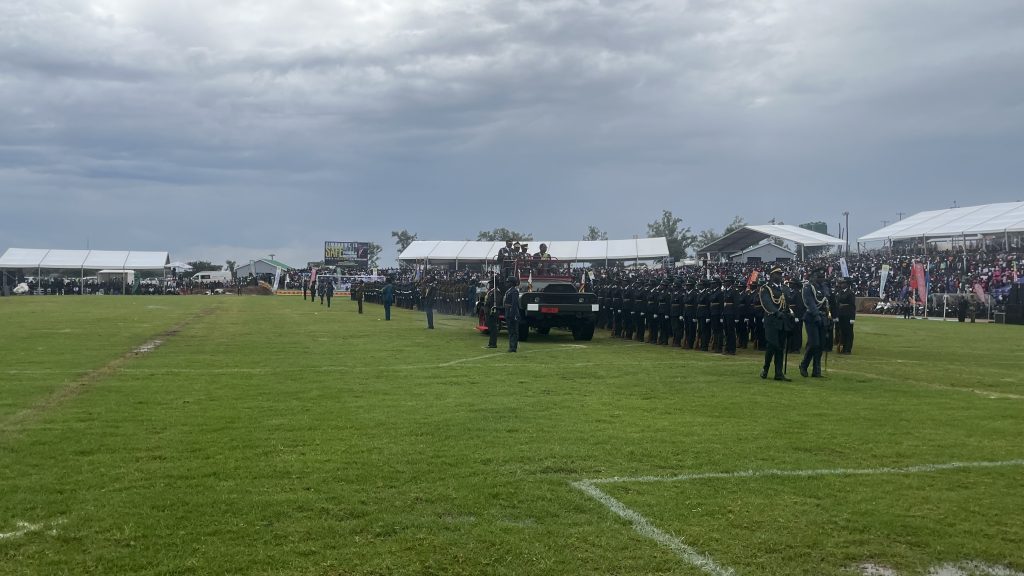
BIG smiles stretch across Maphisa.
Under the grey rain filled skies of Matobo District, communities gather not just in celebration, but in remembrance honouring the forefathers whose sacrifices carved Zimbabwe’s path to independence.
Yet, as the nation marks its 46th Uhuru, something deeper is unfolding in this quiet growth point, a transformation that promises to outlive the songs, speeches and festivities.
The selection of Maphisa to host the 46th Independence Day and National Children’s Party in April 2026 was no ordinary decision.
Announced by Minister of Information, Publicity and Broadcasting Services, Jenfan Muswere following a Cabinet resolution in September 2025, the move reflects a deliberate shift in national planning one that takes development beyond major cities and into historically rich, yet often overlooked communities.
Rooted in decentralisation, the decision positions Maphisa not just as a host, but as a beneficiary of long-term national investment.
Maphisa’s historical gravity made it a natural choice.
Nestled in Matobo District, a region deeply tied to Zimbabwe’s liberation struggle and closely associated with Father Zimbabwe, Dr Joshua Nkomo, the area carries a legacy that resonates with the spirit of independence itself.
For local leaders and residents alike, hosting Uhuru celebrations here is both symbolic recognition and a long-overdue opportunity for growth.
But beyond symbolism, the true story of Maphisa lies in what has been built and what will remain.
A place once defined by modest infrastructure is rapidly evolving into a hub of opportunity. Where there was once a forest, a stadium now rises solid, modern and commanding capable of holding up to 10,000 people.
More than just a venue for national celebrations, the Maphisa Stadium stands as a beacon for sporting excellence in Matabeleland South, with the potential to nurture local talent and revive the province’s football culture for generations.
The transformation extends far beyond sport.
Roads that once slowed movement and economic activity are being rehabilitated, connecting Maphisa more efficiently to Gwanda, Bulawayo and surrounding areas.
These improved transport links are not just about convenience they are lifelines for trade, access to services and regional integration.
Education too, is undergoing a remarkable shift.
At Mahetshe Primary School, designated as the Children’s Party venue, infrastructure upgrades are reshaping the learning environment. New classroom blocks, a 700-seater hall, and science laboratories across the province are laying the foundation for a future driven by knowledge and innovation.
A newly established computer laboratory signals a step into the digital age, ensuring that rural learners are not left behind in a rapidly evolving world.
Healthcare and social services have not been left out.
The construction of a new mortuary and the provision of an ambulance strengthen the district’s capacity to respond to critical needs, while housing projects under the Presidential War Veterans Housing Scheme restore dignity to those who fought for the nation’s freedom.
These are not temporary gestures they are structural changes that improve everyday life.
Equally transformative are the water and electrification initiatives. The drilling of over 40 boreholes and the introduction of solar-powered systems are addressing long-standing challenges of access to clean water and reliable energy.
For many households, this marks a shift from struggle to sustainability, unlocking opportunities for small-scale agriculture, business and improved living standards.
Yet, perhaps the most profound legacy lies in the preservation of history itself. The rehabilitation of the Ratanyana battle shrine, complete with a new monument and museum, ensures that the stories of the liberation struggle are not lost to time. Instead, they are immortalised educating future generations while anchoring Maphisa’s identity in the broader narrative of Zimbabwe’s independence.
Government’s commitment is clear these are not projects designed to fade once the celebrations end.
As Minister Muswere emphasised, legacy projects are intended to deliver tangible, lasting transformation improving access to essential services, stimulating local economies and uplifting communities that have long stood on the margins of development.
For Maphisa, the 46th Independence celebrations are not a peak moment they are a turning point.
The impact will ripple beyond April 18 2026, shaping livelihoods, inspiring investment and positioning Maphisa as a model for rural development across Zimbabwe.
In the end, the true measure of Uhuru @46 in Maphisa will not be the size of the crowd or the grandeur of the event but the legacy it leaves behind.
And in Maphisa, that legacy is already taking root strong, visible, and built to last for life.