


By Rex Mphisa
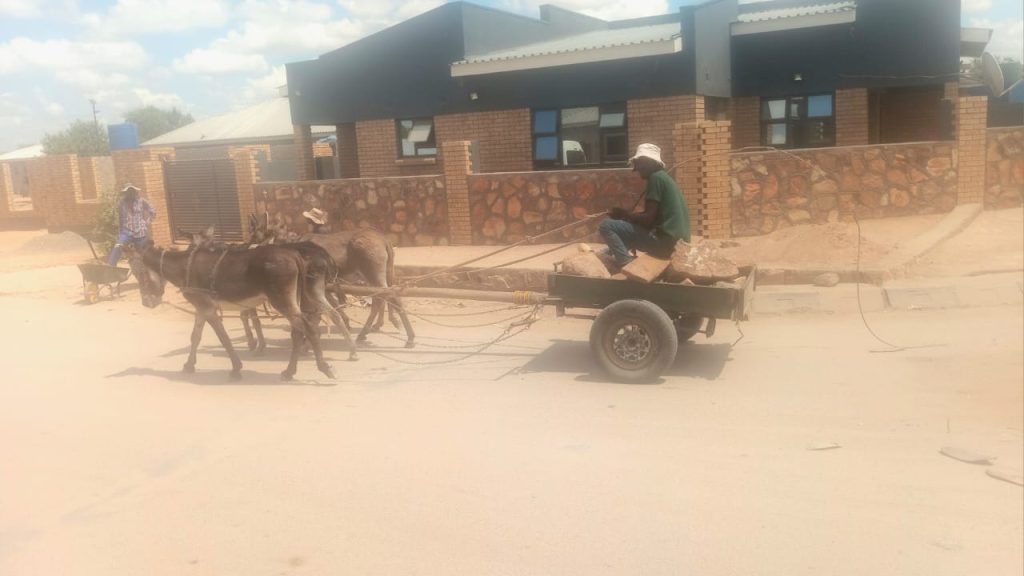
A picture of a donkey-drawn cart in urban Beitbridge captured by Ziyah News Network journalist Prince Chese has stirred a hot debate on local social media.
A lively debate on whether or not the traditional transport model should be allowed into the border town was ignited by the picture.
Frankly the topic divided the cosmopolitan Beitbridge into three groups, those who want donkeys, those who dismiss them as archaic and the surprised!
Others used the topic to wield an embarrassing tribal card.
In Zimbabwe, animal-drawn carts are regulated under road traffic laws requiring specific safety measures and restrictions.
Key rules include mandatory lighting (front white/rear red) at night, prohibition on cycle tracks.
Donkey-drawn carts must have reflectors making them visible to other road users.
While the Act does not ban animal drawn vehicles, local authorities may have bylaws that prohibit such.
Beitbridge has a bylaw prohibiting donkey drawn carts into the central business district and has designated parking places rarely observed.
“When the previous town clerk Singo was detaining these garikis, noone complained. He put order in town. In Bulawayo these carts do not enter the central business district (CBD) but surprisingly people here want them,” former Ward 5 Councillor Granger Nyoni asked.
Nyoni was supported by a regular contributor by the name moniker Soxchas who said there is need to move forward and be modern.
“We need to balance, while nostalgia can help preserve cultural heritage and traditional practices but excessive nostalgia can lead to an overly romanticized view of the past , which hinders progress and innovation and ultimately development,” said Soxchas.
“Historical experiences are used to inform and improve present day decisions not to resist new ideas and change. The issues you raised are important but also require attention and redress, but they dont justify the continued use of Garikis in our town. Singo was the first to introduce regulation of these carts in town. It is part of sanitising the town,” he said.
Soxchas also said in a cosmopolitan set up it is important to give and take in cultures.
“This zvahashu (our culture) mentality is stalling a lot of progress in this town. There is no place (in Zimbabwe) without carts but people accepted changing times and respected urban regulations regulations banning carts from the CBD,” he said.
He was responding to another regular contributor Ronnie VaHungwe who said Garikis were an integral part of Beitbridge.
“Ask the chairman what the advantages of Garikis in town are and he will tell you many. Maybe you were still a toddler when we had the likes of vhoMicah Netsianda, Khumalo, and Aripfani in that industry,” he said.
In contrast most people born in Beitbridge believe there is no need for the town to move forward without donkeys.
Another regular contributor who goes by the moniker “The General” said Garikis showed who the natives of Beitbridge were.
The post was supported by businessman Bheji Muleya who said Beitbridge was built on the animals passage to the river and donkeys must be acceptable.
Another regular contributor Boyd Maphosa said Beitbridge roads were more suitable to Garikis than cars.
He said Beitbridge Municipality roads are even worse than those used by the donkey drawn carts and banning them was a joke.
Other residents spoke about the general welfare of the donkeys accusing their owners of serious ill-treatment.
“Its the cruelty we see on donkeys that makes us feel they should be out of town,” said another contributor.
“While it is acknowledged that donkey carts provide a source of income and transport for low-income residents, their detrimental impact on safety, animal welfare, and city cleanliness makes them unsuitable for urban settings,” said another resident.
But in Shashi and Toporo areas of Beitbridge West, Gariki races have been introduced and villagers join the fun.
The races attract large crowds and could easily be turned into a tourist attraction