


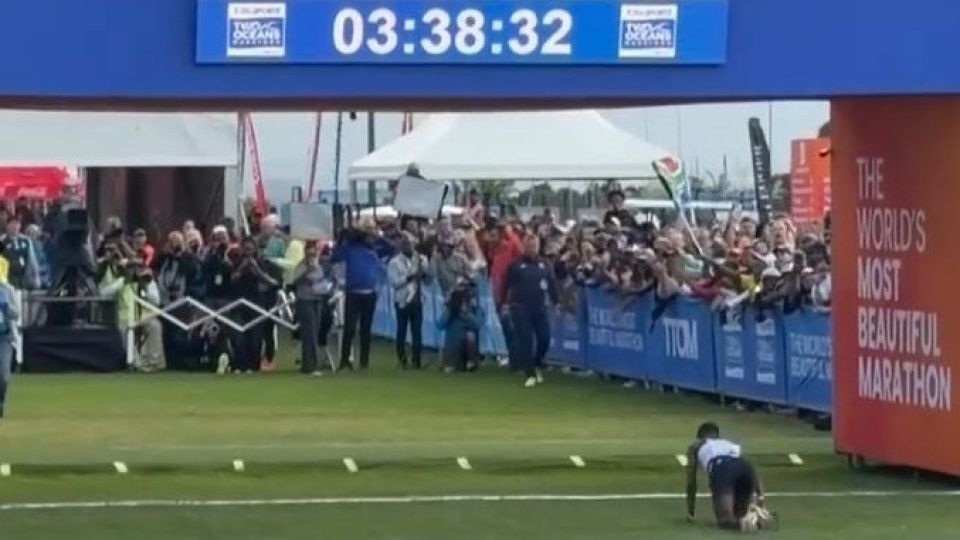
Zimbabwean runner Nobuhle Nobunkosi Tshuma crawled across the finish line at the Two Oceans Marathon, securing a dramatic bronze and a R100,000 prize.
The pavement of Cape Town’s finish line at the University of Cape Town rugby fields became the stage for one of the most visceral displays of athletic perseverance in modern memory. As the clocked ticked toward 3:38:34, Zimbabwean long-distance runner Nobuhle Nobunkosi Tshuma, having pushed her body beyond the threshold of physical endurance, collapsed just meters from the end of the 56-kilometer Two Oceans Ultra Marathon. With the podium in sight but her legs having entirely surrendered to the physiological toll of the race, Tshuma refused to succumb to defeat, dragging her body across the final stretch to secure a hard-earned bronze medal.
For the thousands of spectators lining the final meters, the image of a professional athlete crawling across the finish line served as a haunting reminder of the brutal requirements of ultramarathon running. This was not merely a race it was an intersection of extreme human will and the unforgiving biomechanics of elite distance sport. Tshuma’s finish, while agonizing to witness, secured her third place in one of the most prestigious ultra-endurance events on the global calendar, earning her a prize of R100,000 (approximately KES 780,000) and the respect of a stadium that fell into a rare, stunned silence before erupting in applause.
In endurance sports, the collapse witnessed at the Two Oceans Marathon is often the result of critical metabolic and biomechanical failure. Running 56 kilometers, particularly on a course defined by the elevation profile of the Cape Peninsula—which includes punishing climbs such as Constantia Nek—induces severe glycogen depletion and lactic acid accumulation in the quadriceps and calves. When an athlete’s neuromuscular system can no longer coordinate the complex firing patterns required to maintain a running stride, the body forces a cessation of movement.
- Race distance: 56 kilometers (ultramarathon).
- Elevation gain: Approximately 700 meters across the route.
- Tshuma’s finishing time: 3:38:34.
- Podium context: Finished behind winner Gerda Steyn (3:27:43) and runner-up Margaret Jepchumba (3:33:31).
Sports physiologists note that the decision to crawl—to continue moving even when upright locomotion is impossible—is a psychological phenomenon often studied in ultramarathoners. It requires a decoupling of the brain’s fatigue signals from the motor cortex. While the body screams for rest, the athlete’s internal drive bypasses these signals, prioritizing the finish line over physical preservation. In the case of Tshuma, this decision was the difference between a podium finish and a DNF (Did Not Finish) status.
The Economics of the Endurance Economy
The prize of R100,000, equivalent to roughly KES 780,000, represents a significant capital injection for a professional athlete from Zimbabwe, where sponsorship opportunities for road runners often trail behind those available to competitors in East Africa or Europe. For professional runners, these prize purses are not merely rewards for excellence they are the financial backbone that sustains months of high-altitude training, specialized nutrition, and travel logistics.
The Two Oceans Marathon, having boosted its total prize purse to R2.6 million (approximately KES 20.3 million) for the 2026 edition, aims to remain the most attractive race for regional athletes. However, the disparity between the top prize of R380,000 (KES 2.96 million) and the third-place finisher’s reward highlights the steep financial curve of competitive running. For Tshuma, the bronze medal represents more than an accolade—it is a validation of her investment into a sport that offers limited safety nets for its participants.
Regional Hegemony and the Changing Landscape
The 2026 Two Oceans Marathon results further emphasize the shifting dominance in Southern African road running. While South African runner Gerda Steyn continues to command the women’s field with seven consecutive titles, the emergence of Zimbabwean and Kenyan athletes in the top five indicates a broader, more competitive regional ecosystem. Athletes from across the continent are increasingly utilizing the Two Oceans as a launchpad for careers in larger, international ultra-running circuits, such as the Comrades Marathon or European ultra-trail series.
Analysts following the event noted that the influx of talent from Zimbabwe, Kenya, and Lesotho has driven race times down, forcing domestic South African athletes to innovate their training methodologies. This regional rivalry, while healthy for the sport’s development, places an immense burden on the athletes themselves. As the pace of the frontrunners accelerates, the physical cost of keeping up—as evidenced by Tshuma’s final, grueling meters—continues to rise proportionally.
Ultimately, Nobuhle Nobunkosi Tshuma’s finish at the Two Oceans Marathon will likely be remembered not for the time recorded, but for the stark reality of the effort required to compete at the highest level. In an era where sports data often prioritizes speed, efficiency, and marketability, her crawl serves as a poignant reminder that human performance remains, at its core, a test of the ability to persist when the body finally says no. The bronze medal will sit in her trophy case, but the image of her resilience will linger far longer in the collective memory of the running community.
Meanwhile, a Beitbridge athlete, Bigboy “Zenge” Tshitauze, made his mark on the international stage by shining at the Two Oceans Marathon held in Cape Town on 11 April 2026, where he successfully completed the gruelling 56-kilometre ultra race; the long-distance runner from Tshisavhaya Village in Ward 14 demonstrated exceptional endurance and determination, proudly representing his district among thousands of global participants, while continuing to build his reputation as a dedicated marathon athlete following his recent participation in the Dubai Marathon, inspiring young people in Beitbridge to pursue long-distance running and broader opportunities beyond their community.
Cc: Streamline